Accreditation
ACCREDITATION AT A GLANCE
The U.S. Department of Education states that accreditation is a voluntary process in the United States, with many legitimate, high-quality institutions operating without it. There is no federal mandate requiring schools to be accredited, and each accrediting agency has its own standards, meaning there is no single national consistency. Accreditation is a system of quality assurance provided by non-governmental, peer-review organizations, and the federal government recognizes certain accrediting agencies.
“The United States has no Federal Ministry of Education or other centralized authority exercising single national control over post-secondary educational institutions in this country. The States assume varying degrees of control over education; however, in general institutions of higher education are permitted to operate with considerable independence and autonomy. As a consequence, American educational institutions can vary widely in the character and quality of their programs.”
"In order to ensure a basic level of quality, the practice of accreditation arose in the United States as a means of conducting non-governmental, peer evaluation of educational institutions and programs. Private educational associations of regional or national scope have adopted criteria reflecting the qualities of a sound educational program and have developed procedures for evaluating institutions or programs to determine whether or not they are operating at basic levels of quality." (U.S. Department of Education website)
LEGAL STATUS
Ekklesia Institute Inc.™ is a private faith-based corporation in the state of Florida legally authorized by Florida Department of Education, Commission of Independent Education under Florida Statute §1005.06(1)(f) with religious exemption to offers degrees, programs, certifications, and training designed exclusively for ministry, faith leadership, and religious vocational development. Under the Florida Statue §1005.06(1)(f) Ekklesia Institute Inc.™ is legally authorized to also offer educational programs that prepare students for religious vocations as professionals, or laypersons in the categories of counseling, theology, education, administration, music, fine arts, media communications, or social work.
Ekklesia Institute Inc.™ is not regulated or overseen by any state Department of Education or higher education commission, nor does it operate as a secular academic institution. Under the provisions of religious exemption laws, the Institute is authorized to grant religious degrees, certificates, and credentials solely for ministry, ecclesiastical service, and faith-based leadership purposes.
Academic & Licensing Disclosure
Credits, certificates, or degrees issued by Ekklesia Institute Inc.™:
Do not qualify the holder for state teaching certification.
Do not meet the requirements for professional or occupational licensing examinations.
Are intended exclusively for religious, ministry, and faith-based vocational use.
Individuals seeking state-recognized, professional, or licensure-based qualifications should contact the appropriate regulatory or licensing agency.
Transferability of Credits
The transferability of credits or coursework completed at Ekklesia Institute Inc.™ is not guaranteed and is at the sole discretion of the receiving institution. Students are encouraged to consult with the institution to which they may seek to transfer credits.
Accreditation Disclosure
Ekklesia Institute Inc.™ is not accredited by any agency recognized by the U.S. Department of Education, nor does it seek such accreditation. This allows the Institute to remain fully free to design, teach, and administer its curriculum according to its biblical principles, faith traditions, and organizational mission without external restriction.
The Institute may affiliate with faith-based or biblical accrediting bodies for purposes of accountability and recognition within the religious and ministry education community; however, such affiliations do not imply recognition by governmental or secular accrediting agencies.
In accordance with federal disclosure requirements:
NOT ACCREDITED BY AN AGENCY RECOGNIZED BY THE U.S. SECRETARY OF EDUCATION.
Curricular Autonomy Statement
Ekklesia Institute Inc.™ exercises full religious prerogative to:
Develop a curriculum grounded in biblical values and theological perspectives.
Serve a faith-centered student body.
Offer programs that prepare individuals for ministry, leadership in religious organizations, and service within faith communities.
The Institute makes no claim, express or implied, that its programs or awards are equivalent to those offered by secular, state-regulated, or regionally accredited institutions.
Tax Reporting Information
Ekklesia Institute Inc.™ does not issue IRS Form 1098-T, as it does not offer “qualified tuition and related expenses” as defined by the Internal Revenue Service and does not participate in federal Title IV financial aid programs.
Summary Statement for Clarity
Ekklesia Institute Inc.™ operates as a religious-exempt educational institution authorized to offer faith-based training, ministry credentials, and religious degrees exclusively for spiritual and ecclesiastical vocations. Its programs are not designed for secular academic equivalence or state-regulated professional licensure.


The Doctor of Humane Letters (L.H.D.)
DISCLAIMER
The Honorary Doctorate in Humanitarianism bears no correlation to an academic Ph.D. and is formally categorized as the Doctor of Humane Letters (L.H.D.), conferred In Honoris Causa, a Latin designation meaning “for the sake of honor.”
The Doctor of Humane Letters (L.H.D.) is an honorary doctoral distinction traditionally awarded to individuals who have demonstrated exceptional contributions to society, including but not limited to humanitarianism, leadership, philanthropy, education, social justice, public service, and community development.
Unlike a Doctor of Philosophy (Ph.D.), which is an academic research degree requiring formal coursework, comprehensive examinations, and the completion of a dissertation, the L.H.D. is not an academic credential. It is granted honoris causa in recognition of a lifetime of service, measurable impact, and distinguished achievement that has advanced the betterment of humanity—not scholarly research or academic study.
In short, a Ph.D. recognizes academic mastery and original research, whereas the L.H.D. honors moral leadership, humanitarian service, and societal impact. For this reason, Ekklesia Institute clearly states to all honorees that they are not receiving a Ph.D.
This honorary distinction is awarded solely in recognition of exemplary service, leadership, and humanitarian impact and carries no academic equivalency, academic credit, or research-based standing.
For clarity and ethical use, under globally accepted honorary degree conventions, recipients may use the following formats:
~Dr. (h.c.) John Doe
~Dr. John Doe, (h.c.)
This usage is internationally recognized and appropriate provided the recipient does not represent or imply possession of a Ph.D. or any academic, research-based doctoral degree.
Important Notice:
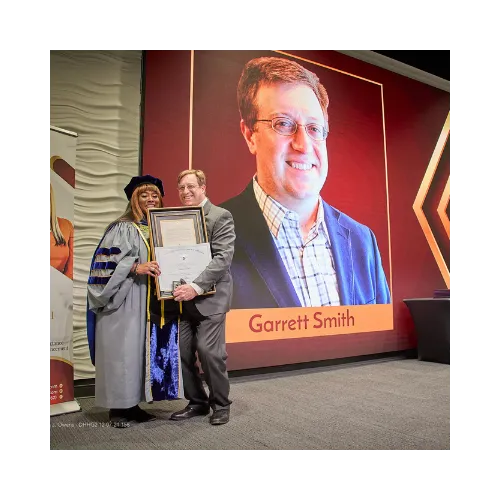
The commencement photos shown were captured during a previous season of collaboration with Global International Alliance.
This organization is not affiliated with the current commencement or its programming.
@ 2026 - Ekklesia Institute Inc™ | All Rights Reserved
*Application and Program Participation Fees Required